
Key takeaways
- Lp(a) is an inherited, LDL-like particle that no standard lipid profile measures.
- About 1 in 5 people has a high level; among South Asians it is roughly 1 in 4, and Indians face heart attacks a decade earlier than Europeans.
- You test once: Lp(a) is about 90 percent genetic and set by around age five.
- High means 50 mg/dL or above (about 125 nmol/L); 30 to 50 is the gray zone; ranges vary by laboratory.
- Get tested if early heart disease runs in your family, or your cholesterol resists treatment.
- A high number roughly doubles or triples heart-attack risk, but it is not a verdict: controlling LDL, blood pressure, sugar, smoking, and weight still cuts total risk.
- If your Lp(a) is high, your siblings, children, and parents deserve the same one-time test.
Book tests from this article
Sample collected at home - free
- Lipoprotein (A) [Lp(a)]
₹1,249₹1,64924% off
- Lipid Profile
₹799₹1,14930% off
- Apolipoprotein - B
₹599₹79925% off
Free collection 24 hr reports
The report that said "normal"
Your total cholesterol was 178. Your LDL sat comfortably inside the reference range. The doctor glanced at the report, smiled, and said everything looks fine.
And yet your father had his first heart attack at 52. Your uncle needed two stents before 60. Somewhere in the back of your mind, a question keeps tapping: if the numbers are fine, why does heart disease keep visiting our family?
Here is the uncomfortable answer, stated plainly. The standard lipid profile measures total cholesterol, LDL, HDL, and triglycerides. It does not measure lipoprotein(a), pronounced "L-P-little-a", written Lp(a). About one in five people carries a high level of it. Your lipid profile can look perfectly normal while Lp(a) quietly doubles or triples your heart-attack risk. This particle is inherited, it barely moves through your whole life, and a single blood test finds it.
If heart disease runs in your family, that one test is worth knowing about.

Lp(a), in plain words
Blood cannot move cholesterol around on its own, so the body packs it into little delivery particles called lipoproteins. You already know two of them from your reports: HDL, the so-called good cholesterol, and LDL, the bad one.
Lp(a) is LDL's stickier twin. Picture a regular LDL particle with an extra protein, called apolipoprotein(a), wrapped around it like a rough coat. That coat changes everything. The particle grips artery walls more tightly, it stirs up more inflammation where it lands, and it interferes with the body's clot-dissolving machinery. In the words of the US National Institutes of Health, Lp(a) particles are stickier than other LDL particles, so they may be more likely to cause blockages and blood clots in your arteries.
Over years, sticky particles build plaque. Plaque narrows arteries. Narrowed arteries feed heart attacks, strokes, blocked leg arteries, and a stiffening of the aortic valve called aortic stenosis. Lp(a) has been tied to all of these.
One more fact, and it matters more than the rest: your genes decide your Lp(a) level. Roughly 90 percent of the variation between people comes down to the LPA gene you inherited from your parents. By around age five, you already carry your adult level, and it stays about the same for the rest of your life. Diet and exercise barely touch it. You cannot eat it down or run it off.
That sounds bleak. It is actually useful information, as the rest of this guide will show.
There is one more twist worth knowing, because it explains a lot of confusing reports. Every standard method for measuring LDL cholesterol quietly includes the cholesterol carried inside Lp(a) particles. The Mayo Clinic's laboratory catalog states this outright: the cholesterol within Lp(a) is included in every LDL measurement. So if your Lp(a) is very high, part of what your report calls "LDL" is actually Lp(a) wearing an LDL costume. This is one reason some patients see their LDL refuse to budge despite strict diets and medicines: a chunk of that number was never diet-responsive LDL at all. Separating the two is one of the quieter benefits of getting the test.
Why no one ordered this test before
Ask most adults in Mumbai what their cholesterol is and they can quote you a number. Ask them their Lp(a) and you will get a blank stare. There are three honest reasons for that.
First, Lp(a) is not on the standard lipid profile. A routine panel reports total cholesterol, LDL, HDL, and triglycerides. Lp(a) needs a separate order, a separate reagent, a separate line on your report. If your doctor never ticked that box, the lab never measured it. It is the most common reason this risk factor stays invisible: nobody looked.
Second, for years the guidelines treated Lp(a) as optional. It sat in the fine print as a "risk enhancer", something a doctor might consider in tricky cases. That changed recently. The 2026 dyslipidemia guideline from the American College of Cardiology and the American Heart Association now recommends measuring Lp(a) at least once in every adult, as a Class I recommendation, the strongest level a guideline issues. India has no equivalent universal rule yet, but cardiologists here are catching up fast, and more labs now offer the test.
Third, there is no approved medicine that lowers Lp(a) specifically. Doctors are human: they hesitate to order a test when the prescription pad offers nothing for it. That logic is weakening. Several gene-silencing therapies are in late-stage clinical trials, given as injections every few months, and early results show Lp(a) reductions of 70 to 100 percent. Whether lowering Lp(a) prevents heart attacks is still being studied, and the answers should arrive within a few years. But even without a dedicated drug, knowing your number changes how aggressively everything else gets managed. That is the real point of the test.
One in five: the Indian numbers
Globally, about one in five adults has an Lp(a) level high enough to clearly raise cardiovascular risk. That figure comes from the Journal of Clinical Lipidology's review of the evidence. One in five. In a local train compartment at rush hour, that is several people in every coach, almost none of whom know.
For Indians, the picture is sharper and less comfortable. Researchers studying Asian Indian heart disease have found that roughly one in four South Asians carries Lp(a) at or above 50 mg/dL, the high-risk threshold. South Asians carry the second-highest Lp(a) levels of any major population group, and the share of heart-attack risk attributable to elevated Lp(a) is the highest anywhere.
This is not an abstract statistic. Indians develop heart attacks about ten years earlier than Europeans on average. Cardiologists describe Lp(a) as the strongest known genetic risk factor for premature coronary artery disease in Indians. An ICMR-published review puts it bluntly: at the same LDL level, an Indian patient carries more cardiovascular risk than a European patient, partly because of this Lp(a) excess sitting on top of low HDL and high triglycerides, the classic Asian Indian lipid pattern.
There is a phrase researchers use for this: double jeopardy. Nature hands you the genetic Lp(a) excess. Nurture adds the modern Mumbai package: long commutes, little movement, rich food, rising diabetes and blood pressure. Each magnifies the other. Knowing your Lp(a) is one of the few ways to see the "nature" half of that equation clearly.
Who should get it checked
With the newest guidelines saying every adult should be tested once, the short answer is: everyone, eventually. But some people should not wait. The US National Institutes of Health lists the situations where a doctor is most likely to order the test:
- A family history of early heart or blood-vessel disease: a father or brother affected before 55, a mother or sister before 65.
- High LDL cholesterol that stays high even on cholesterol-lowering treatment.
- Heart or blood-vessel disease despite normal cholesterol and triglyceride levels, the classic "but my reports were fine" case.
- Signs of familial hypercholesterolemia, the inherited condition that drives cholesterol sky-high from a young age.
- More than one heart attack, or more than one angioplasty to open blocked heart arteries.
Add two more groups that cardiologists now flag. Close relatives of anyone found to have high Lp(a): about 47 percent of first-degree relatives share the high level, so one person's result should trigger testing across the family. And people whose cholesterol numbers and their actual risk do not match: the patient doing everything right whose arteries still clog, or the 45-year-old with a "great" lipid profile and a father who died young of a heart attack.
A question we hear at the counter in Malad captures it well: "My cholesterol is normal. Why are you asking about my father's heart attack?" Because with Lp(a), family history is not background chatter. It is the single best predictor of who carries the high level.
The blood draw itself
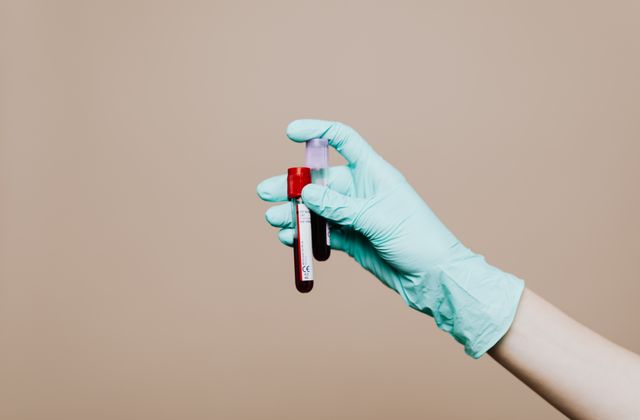
The lipoprotein (a) test is an ordinary venous blood draw. No special machine, no hospital visit, no preparation beyond what your lab tells you. A phlebotomist ties a band around your upper arm, finds a vein in the crook of your elbow, and slips in a needle. You feel a small sting going in, a brief pressure while the vial fills, and then it is over. The whole thing usually takes under five minutes. Afterwards there may be a small bruise or a dull throb at the spot, which fades within a day or two.
At our lab, most Lp(a) samples never involve a lab visit at all. Our phlebotomists do home collection across Malad, Kandivali, Borivali, and Goregaon. They arrive with a kit, find a vein at your dining table, and tape a cotton ball to your arm before they leave. You sit with your arm resting on the table, make a fist while they feel for the vein, and the needle stays in for less than a minute while the vial fills. The sting is brief, the way any blood draw is brief, and then they press the cotton ball down and tape it snug. The sample travels to our Malwani lab in a temperature-controlled box, and the report usually reaches you within about 24 hours. If you are booking from outside those areas, the lab itself is open 24 hours a day, seven days a week.
One practical note: tell the person drawing your blood, or your doctor, if you have had a recent fever or infection. Lp(a) behaves partly like an acute-phase reactant, meaning levels can spike temporarily after surgery, a major infection, or a cardiac event. A doctor may prefer to wait a few weeks after such an episode so the number reflects your true baseline, not a passing storm.
Fasting: what we ask and why
Here is where honest labs admit the guidance is messy. The Lp(a) particle itself does not swing with a meal the way triglycerides do. One NHS laboratory directory lists "no preparation necessary" for Lp(a). The US National Institutes of Health, on the other hand, says you usually need to fast 9 to 12 hours before the draw, and Cleveland Clinic's laboratory protocol asks for 12 hours.
Why the disagreement? Because in real life, Lp(a) is almost never ordered alone. It rides along with a lipid profile, and the lipid profile absolutely needs fasting: triglycerides, LDL, and total cholesterol all read falsely after food. So the fasting instruction follows the panel, not the particle.
Our lab policy is straightforward and it overrides the international debate: at HWP Diagnostic, fasting of 9 to 12 hours is required whenever a lipid profile is drawn, and an Lp(a) drawn alongside it follows the same rule. Water is fine. Morning appointments work best: finish dinner by 9 or 10 pm, skip breakfast, and give the sample before noon.
If your doctor orders Lp(a) entirely on its own, ask the lab when you book. We will tell you exactly what to do. And if you take regular medicines, mention them; some substances, including niacin supplements, aspirin, and hormone preparations, can nudge Lp(a) readings, and your doctor should know.
Two units, one number: reading your report
Open an Lp(a) report and the first thing that confuses people is the unit. Some labs report milligrams per deciliter (mg/dL). Others report nanomoles per liter (nmol/L). Both measure the same thing, and there is no exact conversion between them, because Lp(a) particles come in different sizes and a milligram of small particles is not the same as a milligram of large ones. Roughly, and only roughly, the nmol/L number runs about two to two-and-a-half times the mg/dL number. Do not try to convert your cousin's report into your units with a calculator; compare each number against the range printed on its own report.
With that said, here is the graded picture that current guidelines agree on. In mg/dL: below 30 is low risk, 30 to 50 is the intermediate gray zone, and 50 or above is high risk. In nmol/L: below 75 is low, 75 to 125 is intermediate, and 125 or above is high. The American College of Cardiology and American Heart Association treat anything above 125 nmol/L (about 50 mg/dL) as a significant risk factor, and the National Lipid Association's 2024 update uses the same three bands.
Two caveats, both important. First, ranges vary by laboratory: different machines and methods draw their lines slightly differently, so always read the reference range printed on your own report first. Second, risk is graded, not a cliff. A value of 52 is not magically twice as dangerous as 48; risk rises steadily as the number climbs. Some cardiologists now pay attention even to the upper half of the "normal" range when everything else in the patient's history looks ominous.
What about a very low or even undetectable result? That is good news, full stop. Low Lp(a) causes no health problems at all. Many people have barely measurable levels, and their arteries are simply spared this particular burden.
A quick word on a confusion we see often: the Mayo Clinic's laboratory catalog lists "Lp(a) cholesterol" with a normal value below 5 mg/dL. That is a different measurement, the cholesterol content inside the particle, not the particle mass your report shows. If your report says lipoprotein(a) with a range in the tens, you are looking at the mass measurement, and the bands above apply.
A high number is information, not a sentence
So the number came back at 87 mg/dL. What does that actually mean?
It means your inherited risk of heart attack, stroke, and related artery disease is meaningfully higher than average. Studies put the extra risk at roughly two to three times, in the same league as diabetes as a risk factor. In Indian populations, researchers have found that high Lp(a) confers a two- to threefold risk of coronary artery disease, which is why cardiologists here take this number seriously.
It does not mean you will have a heart attack. Risk factors are not destinies. Plenty of people with high Lp(a) live into their nineties with clean arteries, because risk is the sum of many things and Lp(a) is only one of them. Think of it as learning the monsoon forecast: you cannot change the weather, but you absolutely change how you prepare for it.
A few things can nudge Lp(a) upward without changing your underlying genetics, and your doctor will want to rule them out or account for them. Kidney disease, especially the nephrotic kind, can raise levels. An underactive thyroid can too. Uncontrolled diabetes may play a role. Hormonal shifts matter as well: Lp(a) often climbs after menopause as estrogen falls, which is one reason doctors sometimes check it in postmenopausal women with new risk factors. None of this changes the core message, but it is why a doctor interprets your number in context rather than in isolation.
And here is the part people find hardest to accept: there is nothing you did to cause a high Lp(a). Not the biryani, not the skipped morning walks, not the stress of the last decade. It was decided by a gene lottery before you started school. Guilt is not just unhelpful here; it is factually wrong.
If it's high, this is the plan
A high Lp(a) result should change your medical strategy, not your mood. Here is what that change looks like in practice, roughly in order of importance.
First, everything else gets managed harder. Your Lp(a) may be fixed, but your LDL is not, and neither are your blood pressure, blood sugar, weight, or smoking habit. Cardiologists respond to high Lp(a) by driving LDL lower than they otherwise would, because the total plaque burden is what matters and LDL is the part they can move. If you smoke, quitting now pays off more for you than for the average person. The same goes for blood pressure and diabetes control. The ICMR-published research on Asian Indian heart risk makes this point sharply: the damage from modifiable risk factors is markedly magnified in people carrying the Lp(a) excess. In other words, your healthy habits count double.
Second, your family gets tested. This is the single most valuable thing a high Lp(a) result can trigger. Because the trait is inherited, your siblings, children, and parents each have roughly a coin flip's chance of sharing it, and one blood test settles the question for life. A parent who learns their number at 45 can shape their children's screening decades before any damage is done. If your result is high, tell your first-degree relatives. It is the rare medical finding that protects people who were never in the room.
Third, ask your doctor about the advanced markers that complete the picture. An ApoB test counts the actual number of atherogenic particles in your blood, which tells a truer story than LDL cholesterol alone when Lp(a) is in the mix. An hs-CRP test measures background inflammation, another piece of the risk puzzle. Our Cardiac Risk Markers test bundles several of these together, and the Cardiac Risk Assessment Panel wraps them into broader heart screening.
Fourth, keep perspective on treatment. There is currently no approved medicine that lowers Lp(a) directly. The usual cholesterol medicines barely move it. That may change: gene-silencing therapies now in late-stage trials have cut Lp(a) by 70 to 100 percent in early studies, and the field is watching closely. Until those arrive, the strategy is the one above: know the number, control everything controllable, and screen the family.
Fifth, do not chase the number with repeat tests every few months. Lp(a) barely moves. Once you have a reliable baseline, retesting yearly adds nothing unless something major changed, like new kidney disease or the start of hormone therapy. Save the needle pricks for the markers that actually move.
Questions patients ask us at the counter
Is Lp(a) part of my lipid profile? No. The standard lipid profile reports total cholesterol, LDL, HDL, and triglycerides. Lp(a) is a separate test that your doctor has to order separately, which is exactly why most people have never had it measured.
Do I really need to fast for it? Follow your lab's instructions. At our lab, the honest answer is usually yes, because Lp(a) is almost always drawn together with a lipid profile, and that panel needs 9 to 12 hours of fasting. Water is fine; food, tea, and coffee are not.
I already take cholesterol medicine. Should I still get tested? Yes. The usual cholesterol medicines work on LDL and barely move Lp(a). Knowing your Lp(a) tells your doctor whether your remaining risk needs a more aggressive plan.
Can diet or exercise bring it down? Not meaningfully. Lp(a) is about 90 percent genetic. Diet and exercise still matter enormously for your overall heart risk, they just do not move this particular number.
If I test now, will I need to test again next year? Almost certainly not. Levels are set by around age five and stay stable for life. One reliable measurement is enough, unless a major new condition like kidney disease enters the picture.
My report says nmol/L but my friend's says mg/dL. Which one is correct? Both. Labs use either unit, and there is no exact conversion because the particles vary in size. Compare each result against the reference range printed on its own report.
My LDL is normal but my Lp(a) is high. Am I safe? No, and that is precisely what this test exists to catch. The US National Institutes of Health states it plainly: a high Lp(a) can mean high risk for heart and blood-vessel disease even when cholesterol levels are normal.
Should my children be tested? First-degree relatives, yes. About half of them will share a high level, and one test settles it for life. A teenager who knows can build their whole prevention plan around real information instead of guesswork.
Is there any medicine that lowers Lp(a)? Not an approved one, not yet. Targeted gene-silencing therapies are in late-stage clinical trials with dramatic early results, but for now the proven strategy is aggressive control of every other risk factor.
Getting it done in Mumbai
Booking is simple. You can book the lipoprotein (a) test on our tests page, call us on 84250 40353, or walk into our Malwani lab in Malad West any time, day or night. Home collection is free across Malad, Kandivali, Borivali, and Goregaon: our phlebotomist comes to your door, draws the sample in a few minutes, and your report typically lands within about 24 hours. If heart screening runs in your planning, look at our health packages too, especially the cardiac bundles that pair Lp(a) with the markers around it.
A few practical rules, learned from years of watching where this test goes right and where it goes sideways:
Before the blood draw
Do: book a morning slot after 9 to 12 hours of fasting, since your Lp(a) will almost certainly be drawn with a lipid profile. Finish dinner by 10 pm, drink water freely, and skip the morning chai until after the draw.
Don't: schedule the test in the week after a fever, surgery, or any major infection. Lp(a) can spike temporarily as part of the body's acute-phase response, and you want your true baseline, not a passing storm.
Reading the report
Do: read the reference range printed on your own report first. Cutoffs differ slightly between laboratories and methods, and your lab's range is the one that applies to your number.
Don't: convert between mg/dL and nmol/L with an online calculator and then panic. The conversion is only approximate, and comparing across units is how misunderstandings start.
After a high result
Do: tell your siblings, children, and parents, and nudge them to get the one-time test. Half of them likely share the level, and their prevention plans get better the earlier they know.
Don't: treat the number as a verdict or start skipping the habits that do move risk. LDL, blood pressure, blood sugar, smoking, and weight are all still in your hands, and in people with high Lp(a), controlling them pays off more, not less.
One last thought, because it is the one that matters most. Lp(a) is unusual among heart tests: it gives you bad news you cannot fix directly, about a risk you did not earn. The value of knowing is not in changing the number. It is in changing everything around it, early, deliberately, and across your whole family. A single vial of blood, drawn once in your life, can redraw the map for the people who share your genes. That is a good trade.
To recap the essentials: Lp(a) is an inherited, LDL-like particle that no standard lipid profile measures, and about one in five people (roughly one in four South Asians) carries a high level. You test once, because levels are set by age five and barely move. High means at or above 50 mg/dL (about 125 nmol/L), with a gray zone from 30 to 50, and ranges vary by laboratory. Get tested if early heart disease runs in your family or your cholesterol resists treatment. A high number roughly doubles or triples heart-attack risk, but it decides nothing on its own: driving down LDL, blood pressure, blood sugar, and smoking still cuts your total risk substantially. And if your number is high, your first-degree relatives deserve the same one-time test.
References
- NIH / MedlinePlus: Lipoprotein (a) Blood Test
- Mayo Clinic Laboratories: Cardiology Test Catalog: Lipoprotein (a) and LDL Cholesterol, Serum
- Cleveland Clinic Laboratories: Lipoprotein (a) Test Directory
- Harvard Health Publishing: Lipoprotein(a): An Update on Testing and Treatment
- National Lipid Association: 2024 Focused Update on Lp(a) in Clinical Practice (Journal of Clinical Lipidology)
- American College of Cardiology / American Heart Association: 2026 Guideline on the Management of Dyslipidemia (multisociety)
- Indian Journal of Medical Research (ICMR): Benefits and Risks of Statin Therapy for Primary Prevention of Cardiovascular Disease in Asian Indians
- Enas et al.: Lipoprotein(a) as a risk factor for premature coronary artery disease in Indians (National Asian Indian Heart Disease Project review)
Book these tests at home
Live prices · free home sample collection in Malad, Kandivali, Borivali & Goregaon
Lipoprotein (A) [Lp(a)]
- Report in 24 hrs
- Free home collection
Lipid Profile
- Report in 48 hrs
- Free home collection
Apolipoprotein - B
- Report in 24 hrs
- Free home collection
High Sensitivity C - Reactive Protein (hs - CRP)
- Report in 12 hrs
- At our Malad West lab
Cardiac Risk Markers
- Report in 48 hrs
- Free home collection
More tests related to this topic
Other Heart tests you can book with free home sample collection.
CRP (C-Reactive Protein)
- Report in 12 hrs
- Free home collection
Anti Phospholipid Antibody (APL) - IgG
- Report in 24 hrs
- Free home collection
Anti Phospholipid Antibody (APL) - IgM
- Report in 24 hrs
- Free home collection
Antiphospolipid Syndrome Panel
- Report in 48 hrs
- Free home collection
Apolipoprotein - A1
- Report in 24 hrs
- Free home collection
Cardiac Profile - A
- Report in 48 hrs
- Free home collection
Cardiac Profile - B
- Report in 48 hrs
- Free home collection
Cardiac Profile - C
- Report in 48 hrs
- Free home collection
Cardiac Profile - M
- Report in 48 hrs
- Free home collection
Creatinine Phospho Kinase (CPK) - Total
- Report in 24 hrs
- Free home collection
GD Wellness Cardiac Risk Marker (5 Parameters)
- Report in 24 hrs
- Free home collection
GD Wellness Cardiac Risk Marker (7 Parameters)
- Report in 24 hrs
- Free home collection
Get more from the same visit
Health packages that already include these tests, and tests people usually add.
Frequently asked questions
Is Lp(a) part of my lipid profile?
No. The standard lipid profile reports total cholesterol, LDL, HDL, and triglycerides. Lp(a) is a separate test your doctor has to order on its own, which is why most people have never had it measured.
Do I need to fast before the Lp(a) test?
Follow your lab's instructions. At HWP Diagnostic, the answer is usually yes: Lp(a) is almost always drawn together with a lipid profile, which needs 9 to 12 hours of fasting. Water is fine.
I already take cholesterol medicine. Should I still get tested?
Yes. The usual cholesterol medicines work on LDL and barely move Lp(a). Your Lp(a) number tells your doctor whether your remaining risk needs a more aggressive plan.
Can diet or exercise lower Lp(a)?
Not meaningfully. Lp(a) is about 90 percent genetic. Diet, exercise, and weight control still matter enormously for your overall heart risk; they just do not move this particular number.
Will I need to repeat the test next year?
Almost certainly not. Levels are set by around age five and stay stable for life, so one reliable measurement is enough unless a major new condition appears.
My report shows nmol/L but my friend's shows mg/dL. Which is right?
Both are valid. Labs use either unit and there is no exact conversion because the particles vary in size. Always compare your number against the reference range on your own report.
My LDL is normal but my Lp(a) is high. Am I safe?
No, and catching exactly this situation is the point of the test. A high Lp(a) can mean high risk for heart and blood-vessel disease even when cholesterol levels are normal.
Should my children be tested for Lp(a)?
First-degree relatives should be, yes. About half of them share a high level, and one test settles the question for life, so earlier is better.
Is there a medicine that lowers Lp(a)?
No approved medicine yet. Targeted gene-silencing therapies are in late-stage clinical trials with dramatic early results, but for now the proven approach is aggressive control of every other risk factor.
HWP Diagnostic Editorial Team
Health guides written by the team at HWP Diagnostic, Mumbai, to help you understand your tests before you book. This article is for general education and is not a substitute for medical advice - reference ranges vary between labs, so always discuss your results with your doctor. Read our editorial policy. Photos: Pexels.